I like to think that maybe she found the experience inspiring nonetheless, and that perhaps the Montessori children had taught her just a little bit more about creativity…
Read MoreRecent Articles
Connecting the Dots
And so, Peter spends his days in his Montessori classroom engaged in work that he finds fascinating, challenging, and deeply satisfying. In his mind, a vision of the world is taking shape – a world of tightly woven relationships. He begins to understand cause and effect at a universal level. Above all, Peter’s experiences will help him appreciate the achievements of past generations and realize that he, too, can make positive contributions to the world.
Read MoreThe Silent Journey & Discovery – A Photo Essay
The Silent Journey & Discovery is a powerful event for many parents. Unfortunately, most parents did not attend a Montessori school as a child; although they can read about Montessori philosophy, attend parent nights and observe the classroom, it can be difficult, at times, for them to really understand the experience that their child has every day at school. The J&D provides and opportunity for parents to explore the entire continuum of the school and experience first hand, just like their children, the amazing things that an authentic Montessori program has to offer.
Read MoreApples vs. Oranges
Montessori teachers and school administrators often hear versions of the following questions from parents who are wondering how well their children are being academically prepared in Montessori programs: How does the Montessori curriculum compare to traditional curricula? Are Montessori elementary programs usually academically “accelerated” in relation to their traditional counterparts? How do Montessori graduates compare to other students?
Read MoreKeeping It Real – Part II
The definition of fantasy is: “ideas that have no basis in reality”. Fantasy can be a great tool for escape and entertainment for those of us who have a strong grip on reality. However, young children (before the age of 5 or 6) are not able to differentiate between fantasy and reality; a phenomenon that has dire repercussions on their ability to learn and problem-solve.
Read MorePutting Children First
Every child needs order and routine in their lives, and providing such may be the biggest challenge that we face as parents. With the distractions and demands of both professional and social life, it is easy for us to be distracted and to forget the basic requirement of parenting—giving your undivided attention to your child and to family activity. Your attention provides the order and expectation your child needs to feel secure.
Read MoreEveryone Should Learn Math the Montessori Way
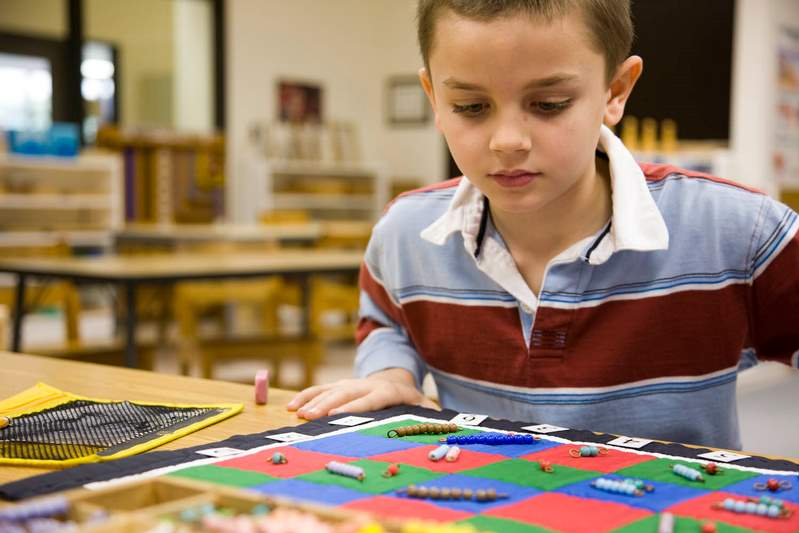
As a student, I started doing math on paper with a pencil; in Montessori the abstract process of math is the final step of a long series of exercises. To me, and most traditional school students, numbers on the page are just that – symbols we are taught how to manipulate. To Montessori students, those symbols represent very concrete ideas that they have physically manipulated; they fully understand what they mean, how they work, and why.
Read MoreKeeping It Real – Part I
We are all aware that creativity stems from a well-developed imagination. You have to imagine something before you can create it, right? We also rightly assume that the capacity to imagine is formed in early childhood (a time when children are read fantasy stories and are encouraged to participate in pretend-play). And yet, you won’t find a single fairy tale, doll, or talking animal in a Montessori classroom!
Read MoreMeaningful Holidays
Focus on developing your family’s own holiday traditions, the ones that arise from your own childhood and your family’s culture and religion, and give your children that most precious gift of all, the gift of your undivided attention and time, of a shared experience of meaning and texture.
Read MoreAdding to Octodecillions (59 digits)
Dr. Montessori observed that children are already motivated to learn. We don’t need to impose motivation on them. In fact, if we give them a little encouragement, they’ll do far more than we would dare ask.
Read MoreMontessori Apps – Help or Hindrance?
There has been much talk recently about Montessori-inspired applications for devices like Apple’s iPhone and iPad – specifically about the apps recently created by Montessorium. Some Montessorians are enraged, feeling that the apps violate the very foundation of Montessori pedagogy. Others love them, and claim that if Dr. Montessori were alive today she would use an iPad in the classroom with the children.
Read MoreAuthentic Motivation
Charlie gave me my first ”ah-hah” moment that not every child needs every lesson. As a new teacher, I had faith in my Montessori training and followed as best I could the guidelines for allowing freedom of choice, freedom of movement, freedom to choose where and with whom to work in the classroom and freedom to talk. I believe these freedoms aided Charlie in learning to tell time.
Read MoreFreedom of Choice Must Be Based on Knowledge
Here, as always, the child’s liberty consists in being free to choose from a basis of real knowledge, and not out of mere curiosity. He is free to take up which of the “radial lines of research” appeals to him, but not to choose “anything he likes” in vacuo. It must be based on a real center of interest, and therefore motivated by what Montessori calls “intellectual love.”
Read MoreMontessori and Play
While one may not see “play” in a Montessori classroom, the spirit of play is very much still there.
Read More

Montessori Social Media